

Lucerne brings together a historic city, a large lake and access to the mountains in a setting that rewards mixing different experiences. You can spend a morning beside the bridges over the Reuss and finish looking at the peaks from the waterfront. On another day, leave the city to see those mountains more closely. The important distinction is between an urban walk and an excursion that depends on connections and the weather.
This selection includes eight places or areas within Lucerne and two outings nearby: Pilatus and Rigi. You do not need to visit both mountains for a satisfying trip. With three days, choose one according to the conditions and your interests. Four or five days provide more room for museums, a boat trip and a second excursion without turning every transfer into a race.
Before you pack
- Destination
- Lucerne, Switzerland; excursions to Pilatus and Rigi
- Suggested stay
- Three days with one mountain; four or five for more
- Planning approach
- Walk the centre; give the lake and mountains separate blocks
- Seasonal detail
- Musegg closes November–March; check mountain transport services
1. Chapel Bridge and Water Tower: begin beside the Reuss
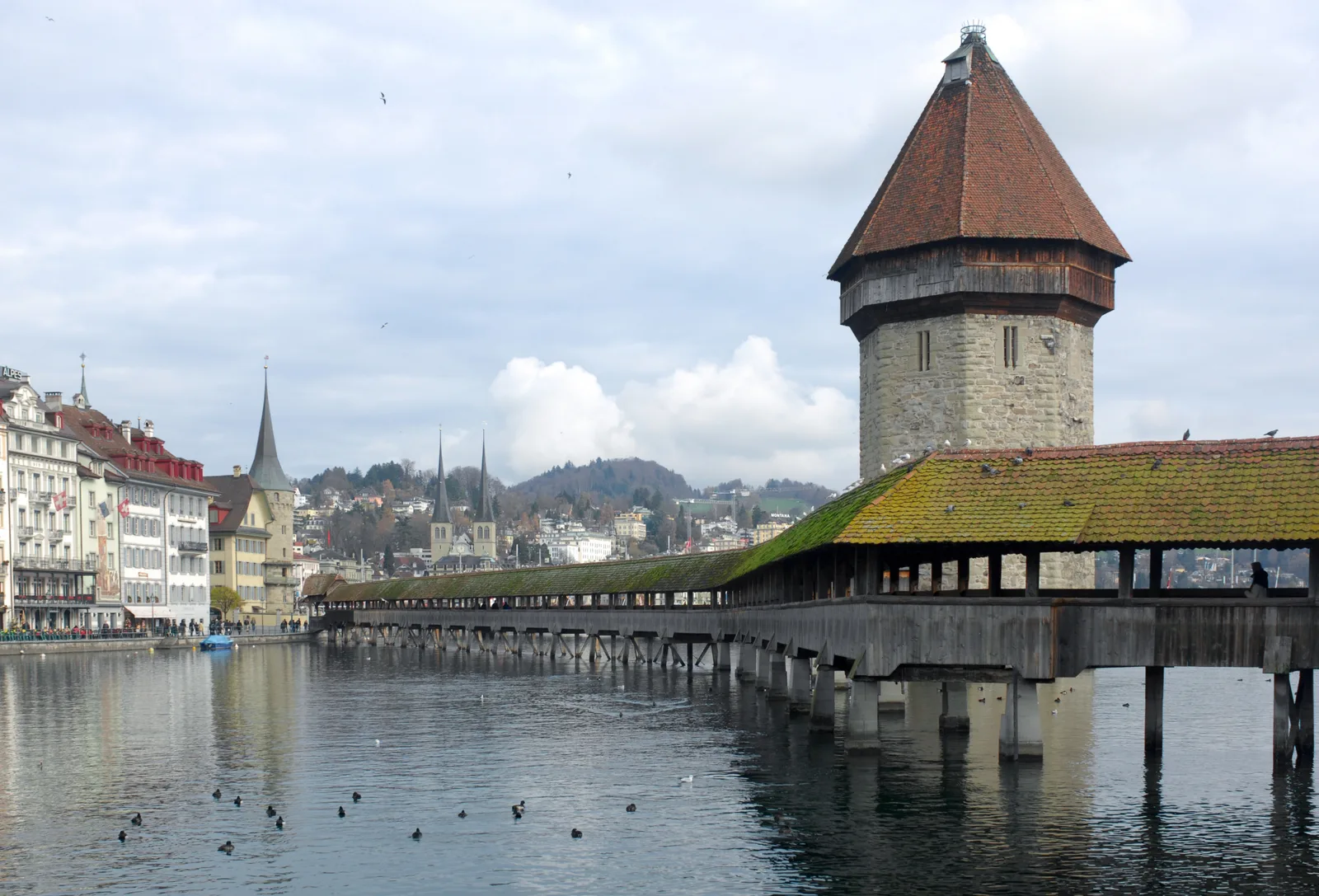
Chapel Bridge, or Kapellbrücke, crosses the Reuss beside the Water Tower. Its covered timber structure is recognisable from a distance, but look at it from the riverbank first: this makes its layout and relationship with the surrounding buildings easier to understand. Then walk across slowly and look at the paintings beneath the roof, stepping aside when you pause so other pedestrians can continue through.
The bridge should not be understood as an untouched medieval structure. Much of it burned in August 1993, and the reconstructed bridge reopened in April 1994. Knowing that history adds a different perspective to the familiar view. Use the bridge as a starting point for Rathausquai and the old town, then look back from the opposite bank to see how the tower and riverfront change their positions within the scene.
2. The old town: make time for squares and painted façades
Weinmarkt and Kornmarkt, home to the town hall, are useful reference points for an old-town walk without an endless checklist of streets. Switzerland Tourism highlights the painted façades and the compact scale of this district. Look above the shop windows as well as into them: the building decoration reveals another layer of the city, and you will notice more by standing still for a few moments.
Begin at the river, turn towards the squares and return to the waterfront when you want a break. This works particularly well on your first day because you can adapt the distance to your energy and the weather. A small area on the map does not have to mean a quick visit. Choosing one square in which to sit and watch everyday activity can be more rewarding than crossing every square without pausing.
3. Spreuer Bridge: another crossing with a different story
A little downstream along the Reuss, Spreuer Bridge is a second covered wooden crossing that deserves attention in its own right. Its Dance of Death paintings, made by Caspar Meglinger between 1625 and 1635, introduce a subject quite different from a picturesque riverside scene: mortality reaches everyone regardless of social position. A small chapel is also incorporated into the bridge.
Rather than treating this as a repeat of Chapel Bridge, spend time with a few panels and notice how their subject changes the experience of the crossing. You do not need to interpret every scene to recognise the theme. Linking the two bridges with a riverside walk gives you several perspectives on the old town. If visiting with children, explaining the images beforehand may help them understand what they are looking at.
4. Jesuit Church: a baroque interior beside the river
The Jesuit Church stands beside the Reuss and offers an indoor visit within a walk between the bridges. Construction began in 1666, and the official inauguration took place in 1677. Local tourism information draws attention to the baroque and rococo stucco, high altar and organ. Having those features in mind encourages a more attentive visit than entering only because you want shelter from the rain.
The building remains a place of worship and is also used for concerts. Check access arrangements and respect any service or rehearsal that limits sightseeing. Do not assume that a musical event is included in an ordinary visit. If the interior is unavailable, you can still appreciate the church within the riverfront scene and continue your walk without reorganising the whole day around a single doorway.
5. Musegg Wall: city views with an important seasonal limit
Musegg Wall and its nine surviving towers reveal Lucerne’s former defences above the old town. Approaching the fortifications helps explain a city that developed around more than its lake: it also needed to protect its approaches. Zyt Tower, with its large clock, is a particularly recognisable feature. Plan the visit according to your comfort with climbing and descending, since this is a different undertaking from a level riverside walk.
The official tourism page consulted states that the wall and towers close from the beginning of November until the end of March. For a winter visit, plan to view the exterior and use the remaining time elsewhere; do not build your day around entering the towers. Outside that closure period, still check which areas are accessible and the conditions before climbing. The presence of nine towers does not mean that all nine can be visited.
6. Lion Monument: understand the memorial before taking a photo
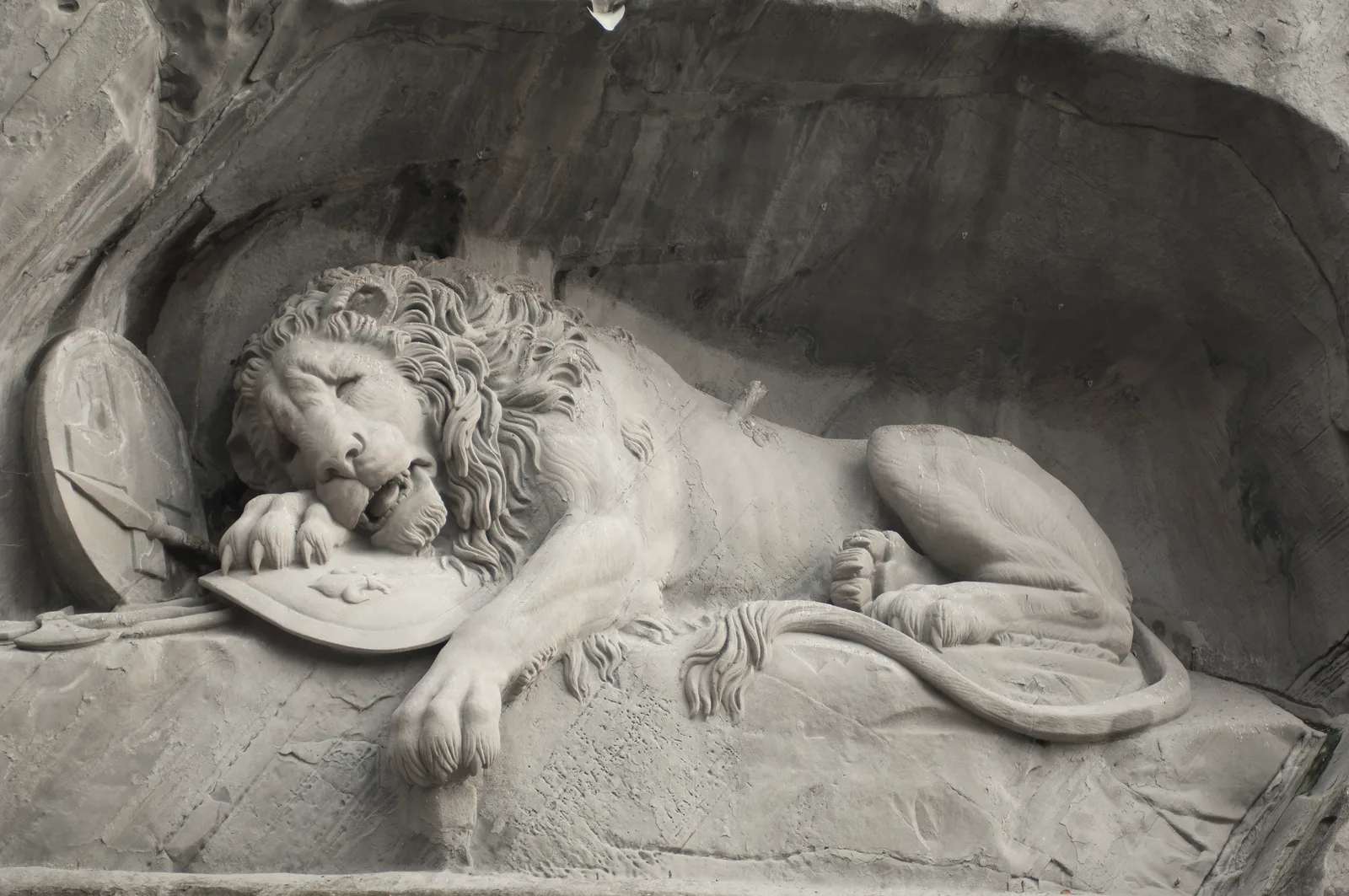
The Lion of Lucerne is carved into a rocky grotto within a park setting. Designed by Bertel Thorvaldsen and inaugurated in 1821, it commemorates the Swiss Guards who died during the storming of the Tuileries in Paris in 1792. That context explains the animal’s suffering expression and makes the stop more meaningful than simply locating a sculpture you have seen in photographs.
Look at the whole setting from a little distance before concentrating on details, leaving space for other visitors to do the same. There is no single emotion everyone must feel here: its interest lies both in the artwork and in the history it commemorates. Include it in a walk through the northern part of the centre, without treating it as an excursion outside Lucerne or assigning it the time needed for a substantial museum.

7. Swiss Museum of Transport: decide what you want to explore
The Swiss Museum of Transport covers movement by rail, road, water, air and space through objects, simulators and interactive displays. An exhibition devoted to energy broadens that focus. It is a strong choice if you are curious about the systems that connect Switzerland, or if your travelling companions would rather experiment and compare vehicles than visit another historic building.
The complex also offers a planetarium, film theatre and Swiss Chocolate Adventure, but several activities in one location do not mean that every ticket includes them all. Check the particular product, session times and language before buying. Give the museum a generous part of the day, especially with children, and choose priorities when you arrive. A lakeside walk can complement the visit; adding a mountain excursion as well is likely to make the day unnecessarily rushed.
8. Lake Lucerne: choose a waterfront walk or a boat trip
Lake Lucerne lets you change the pace without leaving the city. The KKL building beside the railway station and Inseli park provide useful reference points on one shore; the promenade opposite gives you another perspective on the water and mountains. A short waterfront walk may be all you need if you prefer not to devote extra time or money to a boat trip.
If you do take a boat, first decide whether you want a sightseeing journey or a connection to a particular excursion. Vitznau and Alpnachstad feature in regional routes to Rigi and Pilatus, but that does not make every departure a suitable connection. Check the complete journey and return timetable for your season. When visibility is poor, a shorter walk and a museum may be more rewarding than a long cruise chosen mainly for distant views.
9. Pilatus: a mountain outing with several connections
Pilatus is an excursion beyond the city centre, reached by cogwheel railway and cable transport. The route known as the Golden Round Trip combines a boat to Alpnachstad, the railway to Pilatus Kulm, a cable car towards Fräkmüntegg, a gondola to Kriens and a bus back to Lucerne. The journey itself forms part of the attraction, so give it a separate block of time rather than treating it as a quick viewpoint stop.
Use that description as an outline of the route, not a promise that every section operates on every date. Check connections and possible interruptions before buying, together with the forecast and official webcams. Take a warm layer even when walking in the city feels comfortable. At the top, choose only open paths appropriate to your experience: a transport ticket does not make every mountain trail an easy or suitable option.
10. Rigi: another way to experience the lake’s mountain setting
Rigi offers a further mountain excursion from the Lucerne region, combining railways, walking opportunities and views over the surrounding lake landscape. Its operator highlights its association with Europe’s first mountain railway. Vitznau and Weggis are lakeside starting points with different connections, so choose a specific route before travelling rather than assuming that arrival at either village leads to the same ascent.
For a first visit, arrange a straightforward outing with time to stop and enjoy the landscape before returning. The official website publishes timetables and webcams to help you decide whether the conditions suit your plans. If you have already chosen Pilatus and only have three days, keep Rigi for another trip. Visiting both mountains makes sense when you particularly enjoy those journeys and have enough flexibility to change their order with the weather.
A route to get you started
- Day one: begin at Chapel Bridge, explore Weinmarkt and Kornmarkt, then continue towards Spreuer Bridge. Include the Jesuit Church according to access on the day. In the afternoon, choose between extending the walk to the Lion Monument and visiting Musegg if the season permits entry and you still have energy for the climb.
- Day two: give one block to the Museum of Transport and another to the lake. If you prefer a boat trip, check departures and adjust the museum visit to your interests. You can also see the Lion Monument or wall if you left them for later, without trying to fit every indoor attraction into the same afternoon.
- Day three: set aside the day for Pilatus or Rigi after checking weather, services and return connections. A fourth day allows for the other mountain or a slower exploration of Lucerne. Keeping the museum and mountain days interchangeable is particularly useful when visibility changes during your stay.
Good to know
Is one day enough to visit Lucerne?
One day allows time for the bridges, part of the old town and a lakeside walk if you limit indoor visits. To add a substantial museum and one mountain without rushing, this guide suggests three days. The ten places are a selection to help plan a trip, not a checklist that must be completed at any cost.
Should I choose Pilatus or Rigi?
Compare the experience you want, available connections and the forecast for your date. Pilatus offers the circuit involving several forms of transport; Rigi provides another railway and landscape outing. With limited time, choose one and leave room to enjoy it rather than collecting ascents.
Can I enter Musegg Wall in winter?
The official information consulted states that the wall and towers close from the beginning of November to the end of March. During that period, consider an exterior view and another activity. Check the current calendar before travelling, especially when your visit falls close to the change of season.
Do I need a rental car for this itinerary?
The centre works well for walking routes, while the excursions described use boats, trains, buses and mountain transport. Before deciding whether to rent a car, compare those services with your accommodation, mobility needs and the actual return timetable. A transport pass is useful only if its coverage matches the journeys you intend to make.
Lucerne is most rewarding when its bridges, lake and mountains receive time of their own. Use the old town to find your bearings, choose indoor visits that match your interests and treat Pilatus and Rigi as complete excursions. You can then enjoy all ten places during a flexible stay, or choose a shorter selection without feeling that the trip is incomplete.
Sources consulted
- Switzerland Tourism — Lucerne —
- Luzern Tourismus — Chapel Bridge and Water Tower —
- Luzern Tourismus — Spreuer Bridge —
- Luzern Tourismus — Jesuit Church —
- Luzern Tourismus — Musegg Wall —
- Luzern Tourismus — Lion Monument —
- Luzern Tourismus — Swiss Museum of Transport —
- Switzerland Tourism — Pilatus —
- Rigi Bahnen — Official mountain information —